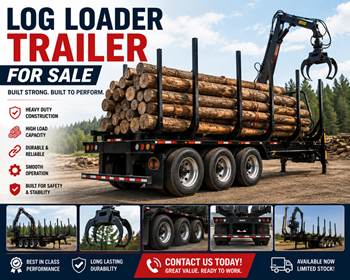
Small woodland properties often present unusual timber handling challenges. Access routes may be narrow, collection points may be scattered, and available working space can be limited. A log loading trailer can help organize timber movement, provided the equipment is appropriate for the property and the operator follows safe loading procedures.
Assess the Property Before Starting Work
Successful timber collection begins with understanding the site.
Walk the intended working area and identify slopes, soft ground, overhead obstacles, and restricted access points.
Consider where logs will be collected and where they must eventually be transported.
Identify Practical Collection Areas
A collection area should provide enough space for equipment positioning and loading movements.
Avoid locating timber piles where they obstruct access routes or create hazards near buildings and utilities.
Where possible, choose firm ground that remains accessible during expected working conditions.
Match Equipment to Available Space
Small woodland areas do not necessarily require large machinery.
Equipment suitability depends on log dimensions, handling frequency, and access restrictions.
A log loading trailer should be compatible with the towing arrangement and capable of operating within the available turning space.
Evaluate Turning Requirements
Narrow woodland paths can make maneuvering difficult.
Consider trailer length, articulation, and the turning characteristics of the towing machine.
Identify safe turning locations before entering confined areas.
Avoid reversing near people, buildings, or hidden obstacles without appropriate visibility and precautions.
Organize Timber Before Collection
Logs scattered across a property require additional handling.
Where safe and practical, arrange timber into manageable collection groups.
Separate material that is unsuitable for the intended loading arrangement.
Group Similar Dimensions
Organizing logs by approximate length and diameter can simplify loading.
It also helps operators plan weight distribution and identify pieces that require special handling.
Avoid stacking logs in unstable piles.
Use appropriate methods to prevent stored timber from rolling unexpectedly.
Establish a Safe Loading Procedure
Mechanical loading requires a clear working area.
Keep bystanders outside the equipment’s operating zone.
Inspect lifting attachments and confirm that each log is within the rated lifting capacity at the intended reach.
Maintain Equipment Stability
Ground conditions can affect loading safety.
Position equipment according to manufacturer instructions and use fitted stabilizers correctly.
Do not attempt to compensate for unstable ground by making unusually fast or forceful movements.
Stop work if equipment shifts unexpectedly.
Coordinate Loading and Transportation
An efficient collection process considers what happens after the trailer is loaded.
Ensure the intended route remains accessible under the loaded condition.
Secure timber using suitable restraints and verify that the load remains within permitted limits.
Plan the Unloading Area
Unloading requires as much preparation as loading.
Choose a stable location with adequate clearance.
Ensure logs can be placed without creating unstable piles or blocking access.
Keep people clear of areas where timber could roll or shift.
Maintain Equipment Between Sessions
Small woodland operations may involve long periods between equipment use.
Storage and inspection therefore become particularly important.
Clean accumulated debris, inspect hydraulic connections where fitted, and check tires and structural components.
Follow recommended lubrication and servicing procedures.
A regional timber equipment information location may offer an additional reference when exploring woodland handling arrangements.
Conclusion
A log loading trailer can make timber collection more manageable on small woodland properties when operators carefully consider access, working space, and loading requirements. Organized collection points, stable equipment positioning, and secure transportation help reduce unnecessary handling. By planning the complete movement of timber before work begins, property owners can create a more efficient and controlled woodland operation.